
Most of us take bathroom convenience and privacy for granted but people haven’t always had the level of bathroom luxury that we enjoy today. In ancient Roman and Asian societies, for example, bathing and toilet facilities were shared. For the poor and middle classes, these facilities left much to be desired. The wealthy enjoyed cleaner and more pleasant facilities but the bathroom experience was still communal. When the Roman Empire fell, the bathroom experience only got worse. Eventually, public facilities had to be closed down somewhere in the 16th century, blamed for widespread sickness.
It wasn’t until the end of the 16th century that the first flushing toilet was invented in England. It was installed in a separate room in the castle to allow the Queen of England privacy but, unfortunately, the toilet didn’t flush well and wasn’t a big hit with the queen.
During the Industrial Revolution, toilet enclosures were built for use on city streets to accommodate workforce needs in the big cities. Some public toilets went underground during the Victorian era as less space became available at street level. These facilities were held to a high standard by the local health boards and provided a higher level of privacy.
The bathroom evolved further during the Industrial Revolution and early 20th century. As more and more women shopped and worked out of the home, private retiring rooms with partitions were developed to accommodate their needs and afford additional privacy.
In 1904, Frank Lloyd Wright, the great American architect, and innovator came up with an innovative way to make it easier to keep toilet enclosures clean. While working on the design of the Larkin Building in Buffalo, NY, he designed the first ceiling hung toilet partitions as well as suspended toilet bowls and sinks.
Partitions Allow For Greater Privacy
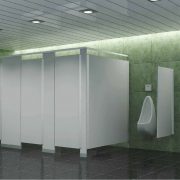
It certainly has taken a while to evolve the concept of the modern restroom that allows for individual privacy and provides a pleasant and sanitary space. In the last century, toilet partitions have played an important role in ensuring bathroom privacy. Over time they too have evolved, starting with the first, basic partitions made of wood or powder-coated steel, to a range of partitions developed over the last 40 years, such as baked enamel, laminate, phenolic, and stainless steel. Unfortunately, these materials don’t stand up to the wear and tear of today’s public bathroom and present many disadvantages:
- They are prone to scratches and dents
- Graffiti is not easily removed
- They are susceptible to moisture and humidity
- The core materials can be a breeding place for mold and bacteria
- Maintenance issues outweigh any initial cost benefits
A more innovative approach to partitions has solved these problems while creating modern partitions that are extremely durable, aesthetically pleasing and sustainable.
Partitions for the 21st Century
Made from HDPE Plastic, Scranton Products restroom partitions offer a unique combination of sophisticated aesthetics, innovative design, superior privacy, and outstanding durability. A solid-core and non-porous surface make HDPE partitions highly resistant to moisture and humidity, therefore, these partitions never rust, corrode or need painting. They are resistant to mold and bacteria, resist dents and scratches, and graffiti easily wipes off.
Public restrooms have come a long way since the “communal experience.” Today, we expect public restrooms to provide a high degree of privacy, cleanliness, as well as high design. With its Aria Partitions®, Eclipse Partitions® and Hiny Hiders Partitions® product lines, Scranton Products offers a range of options that include sleek, modern design and the higher in privacy, making them the best choice for today’s public bathroom environments.
To learn more about Scranton Products bathroom partitions options, contact our sales specialists today. You can also download one of our product brochures for more detailed information.
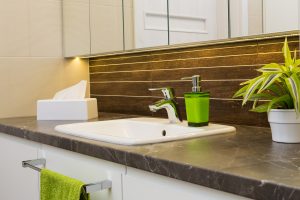 You’ll be able to spot mold sprouting in the corners of your bathroom, but that’s not the only place it can grow. Often, mold begins to sprout inside
 Students aren’t always gentle with the lockers in your school. In fact, they can sometimes be a bit rough. Most students choose slamming the locker shut as their preferred method of closing it, and over time, this can result in the locker door and frame becoming dented. Worst of all, this can cause the lockers to become less secure.
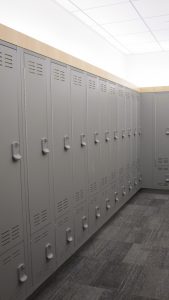 When you notice the unsightly dents, you’ll want to fix them before they get worse. Take a rubber mallet, or a flat hammer, and with medium force, strike the dent. You should have a hard flat surface behind the opposite direction of the dent to ensure that the dent evens out. Using light to medium force, strike the dent a few times. It’ll start to flatten out and become more even with the locker’s surface. You’ll want to complete this action after school hours due to the loud noise that’s expected when hammering the locker—you won’t want student distraction to be an issue.
 You may not really take the time to consider the variety of materials that can be used as toilet partitions. However, reviewing all of your options can allow you to make the best choice for your facility. Most toilet partitions are made from plastic with an inner core made from kraft paper or cardboard. Materials like Phenolic, Baked Enamel, and Plastic Laminate may look nice in your restroom, but they may be left vulnerable to the moisture and humidity in your restroom. The inner core will absorb the moisture, and over time, it’ll sprout mold, leading to a pungent odor and a substantial problem to solve.
 A Material That Lasts